
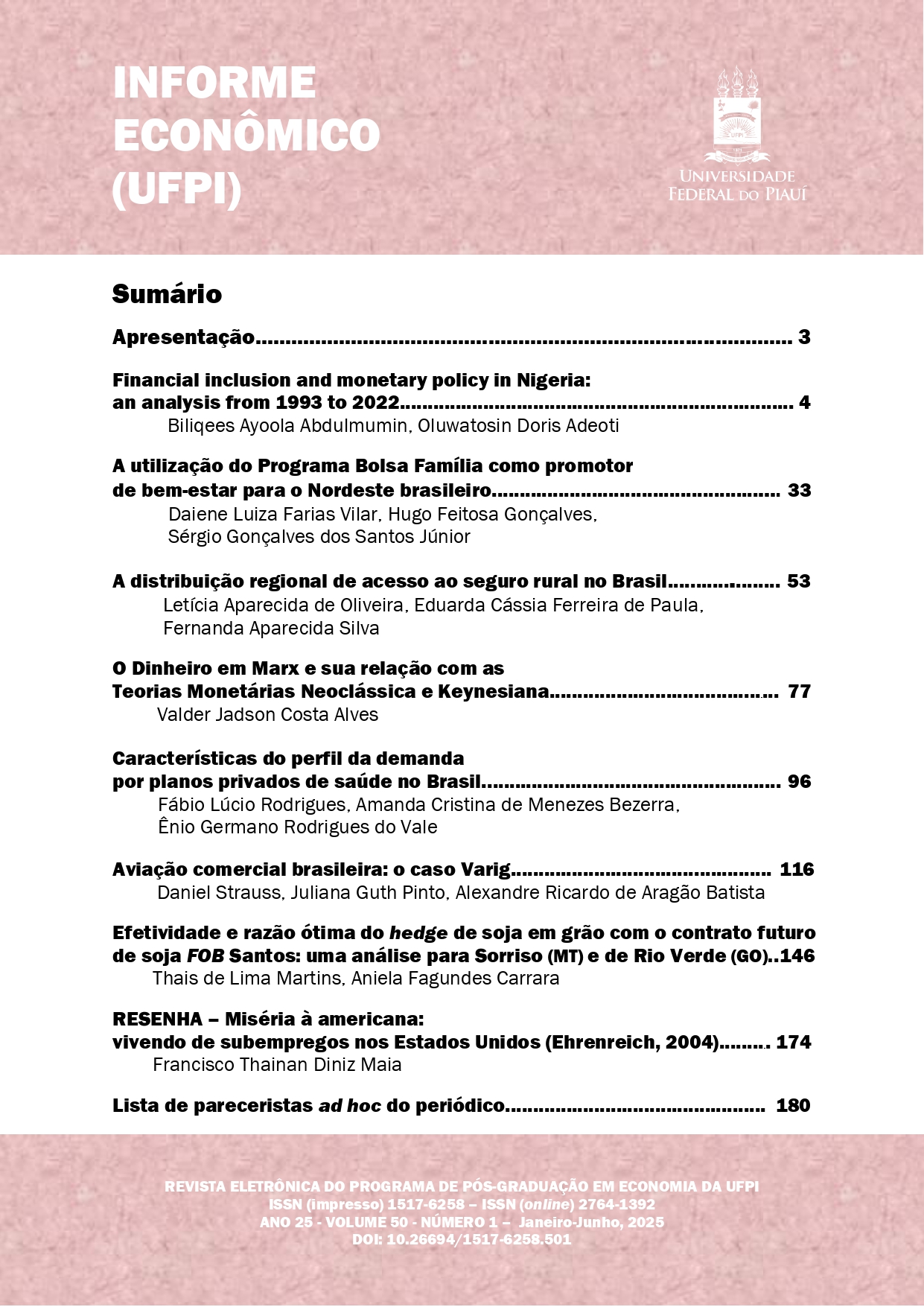
O Dinheiro em Marx e sua relação com as Teorias Monetárias Neoclássica e Keynesiana
DOI:
https://doi.org/10.26694/2764-1392.6579Keywords:
Money, Marxism, Keynesianism, MonetarismAbstract
This article aims to discuss money in Marx, separating it from Keynesian and neoclassical monetary theories, with the aim of contributing to a better understanding and consolidation of Marxist monetary thought. The work is divided into three sections in addition to the introduction and conclusion. The first section presents the evolution of the category of money in Marx, as well as its possible consequences for understanding current problems, namely the issue of fiduciary money and inconvertible credit. The second section criticizes the neoclassical current of monetary theory. The third section does the same in relation to Keynesian monetary theory. The conclusion seeks to express in a more synthetic way the differences between the theories mentioned, aiming to consolidate Marxist monetary theory free from Keynesian and neoclassical interpretations.
References
CARVALHO, F. J. C. Uma contribuição ao debate em torno da eficácia da política monetária e algumas implicações para o Caso do Brasil. Revista de Economia Política, v. 25, n. 4 (100), p.323-356, out.-dez. 2005.
CORAZZA, G.; KREMER, R. L. Friedman e o Monetarismo: A Velha Teoria Quantitativa da Moeda e a Moderna Escola Monetarista. Revista Análise econômica, n. 40, ano 21, set. 2003.
FOLEY, D. The Value of Money, the Value of Labor-Power, and the Marxian Transformation Problem. Review of Radical Political Economics, v. 14, p. 37-49, 1982.
_____. Marx’s theory of money in historical perspective. In: MOSELEY, F. (Ed.). Marx’s Theory of Money: Modern Appraisals. Londres: Palgrave, 2005.
FRIEDMAN, Milton. Quantity Theory of Money. In: Eatwell et al. The New Palgrave: Money. London: The MacMillan Press, 1990.
FRIEDMAN, M.; SCHWARTZ, A. A monetary history of the United States. 1867-1960. Princeton: Princeton University Press, 1963.
FRIEDMAN, Milton; SILVA, Luiz Carlos do Nascimento. Episódios da história monetária. Rio de Janeiro: Record, 1994.
KEYNES, Jonh Maynard. Teoria geral do emprego, do juro e da moeda. São Paulo: Abril Cultural, 1985.
MARX, Karl. O Capital: crítica da economia política. Livro I: O processo de produção do capital, volume I. Rio de Janeiro: Civilização Brasileira, 2012.
MARX, Karl; ENGELS, Friedrich. O Capital: crítica da economia política. Livro III: O processo global de produção capitalista, volume 6. Rio de Janeiro: Civilização Brasileira, 2008.
MOLLO, M. L. R. Moeda e taxa de juros em Keynes e Marx: observações sobre a preferência pela liquidez. In: ENCONTRO NACIONAL DE ECONOMIA, 15., Curitiba. Anais..., Curitiba, ANPEC, p. 205-223, 1987.
_____. Ortodoxia e Heterodoxia Monetárias: a Questão da Neutralidade da Moeda. Revista de Economia Política, vol. 24, n. 3 (95), jul.-set., 2004.
MOSELEY, F. Money has no price: Marx’s theory of money and the transformation problem. In: Marx’s Theory of Money. Palgrave Macmillan UK, 2005, pp. 192-206.
_____. The determination of the ‘monetary expression of labor time’(‘MELT’) in the case of non-commodity money. Review of radical political economics, 43(1), pp. 95-105, 2010.
PRADO, E. F. Da controvérsia brasileira sobre o dinheiro mundial inconversível. Revista da Sociedade Brasileira de Economia Política, 35, pp. 129-152, 2013.
RICARDO, David. Princípios de economia política e tributação. São Paulo: Abril, 1996.
ROTTA, T. M. & PAULANI, L. M. A teoria monetária de Marx: atualidade e limites frente ao capitalismo contemporâneo. Revista Economia, 10(3), pp. 609-633, 2009.
SMITH, Adam. Inquérito sobre a natureza e a causa da riqueza das nações. Lisboa: Fundação Calouste Gulbenkian, 1981.
Downloads
Published
How to Cite
Issue
Section
License
Copyright (c) 2025 Informe Econômico (UFPI)

This work is licensed under a Creative Commons Attribution 4.0 International License.